I don’t recommend people stay on Elon’s hell site, but if you are going to be there then you better be shit posting as good as Captain Pike.
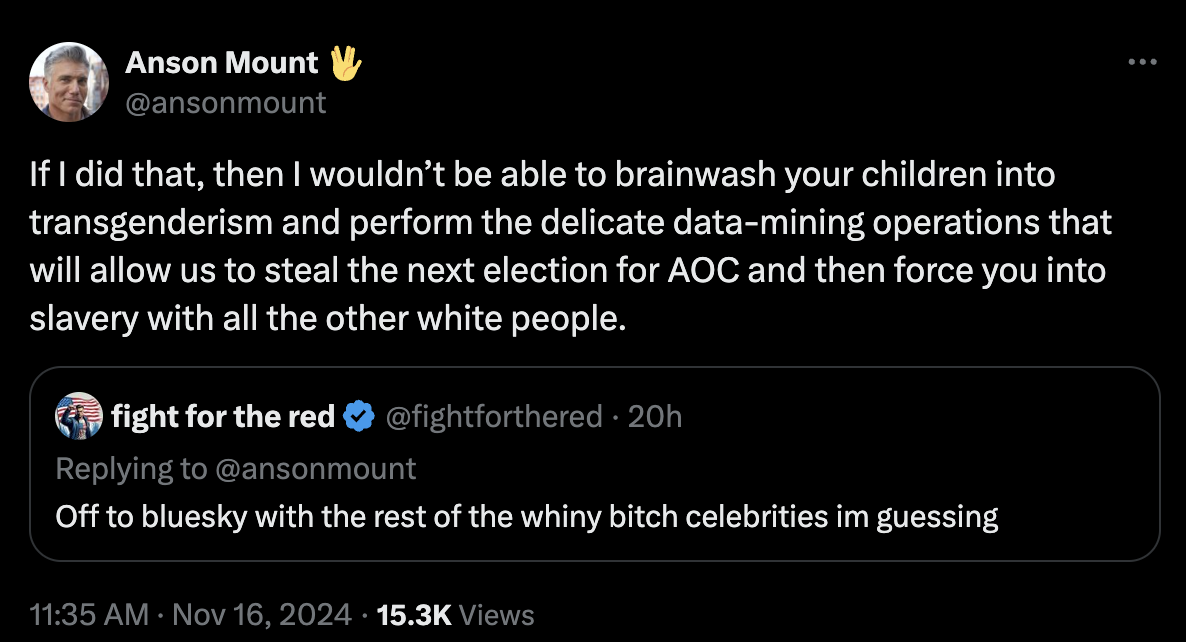
Anson Mount 👋 @ansonmount:&10;“If I did that, then I wouldn’t be able to brainwash your children into transgenderism and perform the delicate data-mining operations that will allow us to steal the next election for AOC and then force you into slavery with all the other white people.”&10;Quoted reply from fight for the red @fightforthered:&10;“Off to bluesky with the rest of the whiny bitch celebrities im guessing”

I’ve no idea who made it, it’s undoubtably AI slop, and yet it is arguably museum worthy art for our times.

An oversized, colorful baby play mat and activity gym is set up on the South Lawn of The White House where Trump's hillbilly cage match monstrosity is in actual life.

RIP Marjane Satrapi, author of the influential indie comics that have continued to find new readers for over 25 years, and are especially relevant now.
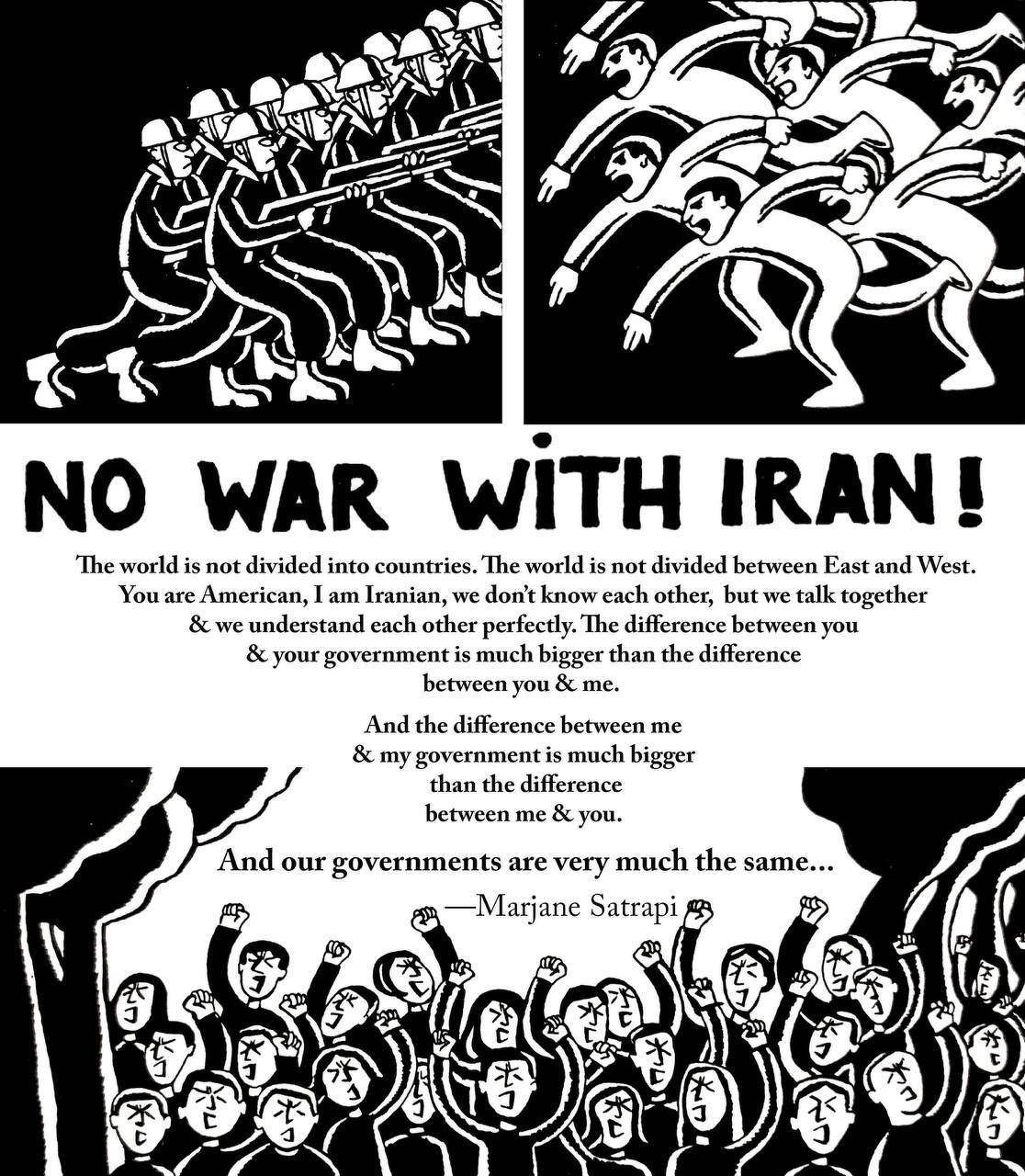
NO WAR WITH IRAN!&10;&10;The world is not divided into countries. The world is not divided between East and West. You are American, I am Iranian, we don't know each other, but we talk together & we understand each other perfectly. The difference between you & your government is much bigger than the difference between you & me. And the difference between me & my government is much bigger than the difference between me & you. And our governments are very much the same.&10;&10;— Marjane Satrapi

Fascist rhetoric wrapped in a css stylesheet aimed at co-opting retro, ironic 1980s nostalgia is still fascist rhetoric. America is going backwards, but more like the 1930s, and in Europe. If you’re waiting for an election in 2028 to save the U.S., that’s going to be too late.
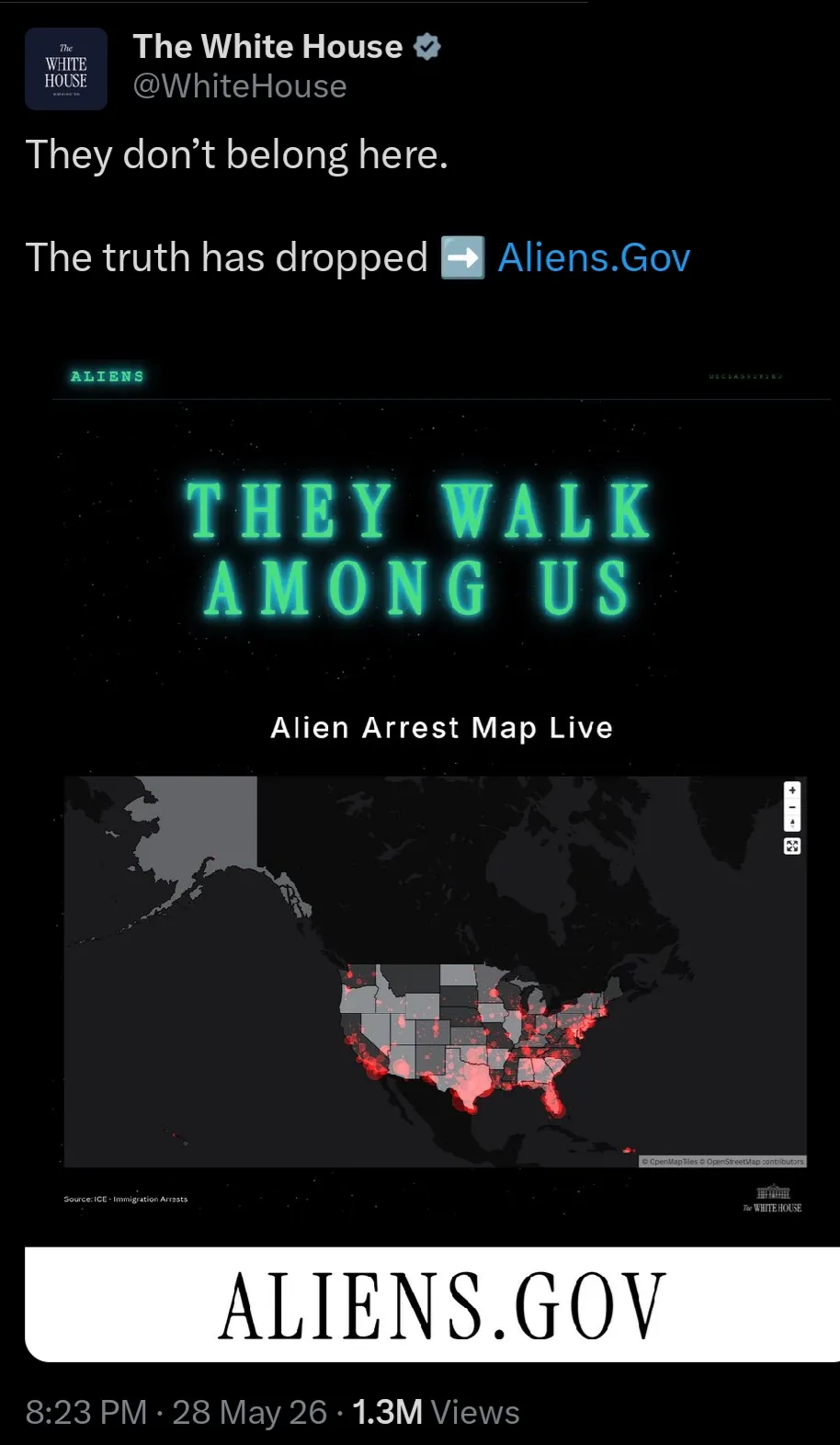
This is the White House's tweet on X promoting it's new aliens.gov site. Tweet says: they don't belong here. The Truth has dropped. The site says "they walk among us" shoes an "arrest map" of alleged illegal migrants, which we know is over-egged, lots of people are being falsely arrested, even deported. Below that it has, in white house font, the domain: aliens.gov.

INTERVIEWER: “So, how do you write, exactly?”

J. G. BALLARD: “Actually, there’s no secret. One simply pulls the cork out of the bottle, waits three minutes, and two thousand or more years of Scottish craftsmanship does the rest.”

source


The Trump Administration is rebuilding the federal government and removing the agencies.

The National Design Studio says its job is to redesign how Americans experience their government but I think the job that they’re actually redesigning is how the government experiences its citizens. — The Drey Dossier


The world’s bullies can still break cities. What they can no longer assume is that broken cities mean obedient people. — John Sipher, The age of asymmetry – the weak have learned how to make the strong bleed


"Internationalism Is Not a Luxury, but a Survival Mechanism"

Superb interview with Syrian author Leila al-Shami and Ukrainian activist Oleksandr Kyselov on the vestigial Eurocentrism and American exceptionalism of the Western “anti-imperialist” Left in an increasingly multipolar world.


Greater Israel: How a fringe settler fantasy went mainstream Israel’s settler movement has moved from the fringes to having influence over key Israeli institutions, including the media, where a constellation of voices is pushing for Israel to conquer new territory. — Al Jazeera’s The Listening Post


Went to the city to see the Banksy statue on Pall Mall. With Reform sweeping so many council elections this week its arrival is well timed.

A statue by Banksy depicts a slightly corpulent man in a suit holding a large flowing flag, set against a clear blue sky. The flag covers his face. The pose is as though he is walking ahead. One foot is on the plinth and the other is ahead, nothing underneath as though he is walking off a cliff, blinded by nationalism.

I have the #KeepItOn 2025 report on internet shutdowns in a tab on my browser.

Not a single day of 2025 passed without at least one internet shutdown.


Something broke in Lusaka

Zambia’s last-minute cancellation of RightsCon was more than bureaucratic theatre. It was a signal of a harder, more adversarial world in which regimes feel more comfortable impeding civic organising.


The revolution will not be podcasted

Forces of nature are ripping through the world now, from energy crises to assassination attempts. The podcast world is finally getting riled up over reality, talking in very urgent tones and throwing around words like famine and genocide, and yet you can hear it in their voices. You can see it in their faces. Sometimes, they even say it out loud: They don’t believe they’ll be affected. They think it’s just going to happen to the rest of us, the ones working two or three jobs, the ones who don’t have six figures sitting in bank accounts, the ones who don’t have a line into the world of insider trading and polymarket grifts. … For them, it’s another topic.

— Jessical Wildfire, in “Our Struggles Make Great Content for The Podcast Class”


No, the chatbot didn't cure that dog's cancer

It’s Easter Sunday. To celebrate, I took the Windrush line up to Hoxton, had festive Swedish meatballs at the Curious Yellow Kafe, then wandered through Shoreditch under that thin, deceptive spring sun London offered today. On the train back south, the miracle arrived in my idle-time phone scrolling. It happened somewhere between Whitechapel and where the internet cuts out when the train goes underground for a few stops. A tech bro cured his dog’s cancer with ChatGPT. It’s an Easter story, neatly packaged for the feed. Like, share, move on. Don’t miss your stop.

Auto-generated description: A man smiling next to a dog is featured with a message about using AI to create a cancer vaccine to save his dog.

Read the story, why do that? There was a preview card. A toothy, smiling white man and his happy Staffy mix. The headline completes the Hallmark Channel story for our times: “He used AI to create a cancer vaccine to save his dying dog.” The ChatGPT logo floats just above the dog’s head, like a halo in a Renaissance painting of a saint. The story completes itself without the need of clicking through, or dealing with cookie consent forms, various pop-ups, a paywall, an e-newsletter subscription request, or whatever else nearly every commercial news site throws at you with javascript. We are living in miraculous times.

Auto-generated description: A smiling man sits beside his dog, who is wearing a bandana, accompanied by text about using ChatGPT to help develop a custom vaccine for the dog's cancer.

This is how most information moves now. Not through articles, but through surfaces. Preview cards, thumbnails, captions. Carefully assembled fragments designed to survive the scroll. The article itself exists, somewhere beneath, but it’s now almost incidental. By the time you might click, you’ve already decided what happened.

And this one lands because it’s engineered to. Cancer does the heavy lifting. The dog does the rest. It disarms you, makes scepticism feel inappropriate. It’s Easter after all.

But here’s the twist! It’s not just medicine, but AI! The bot we can all access to lazily respond to emails we’d like to ignore is being used by some wunderkind Down Under to cure cancer. We all have access to the thing that cures cancer. Or something like that. Or rather, no. It’s nothing like that.

Read these or don’t, can’t say you didn’t get the chance: To varying degrees, these are all hype headlines. The articles themselves vary in quality and detail. They all contain elements of the mythology that makes them sharable. The UNSW headline is especially egregious, it’s a university for fuck sake have some standards.

What actually happened is slower, messier, and much less cinematic. It’s not even a particularly good Netflix series. Multiple rounds of conventional treatment didn’t work. The dog’s owner, with access, privilege and resources, pushed further into the system rather than bypassing it. DNA sequencing, researchers, lab work, a bespoke mRNA construct manufactured by specialists (not bots), layered with another form of immunotherapy. Ethics approvals. The AI is there throughout, but as a tool in the process, helping navigate research and make sense of data, not designing, manufacturing, or delivering treatment. The result isn’t a cure. It’s a partial response. It’s a treatment. Uneven, uncertain, and still unfolding.

That version of the story doesn’t travel. First off, it’s too complicated. Secondly, there’s no tidy hero element. No archetype pulled from the offspring of an Ayn Rand character template and a Robert F. Kennedy health policy. There’s a reason that Elizabeth Holmes conned people for so long. We’re conditioned to believe in unicorns. It slots neatly into something older. The founder myth: The outsider who breaks through where experts failed. The idea that you don’t need institutions, just ingenuity and the right tools. Being a drop out is even better. Not knowing the field is somehow an advantage, not a limitation. We want the dropout to win. It’s a comfortable tale because we’ve seen it before, in different forms, attached to different sectors, technologies, selling different shortcuts. The thing about unicorns, though, is that they aren’t real. It’s a team of special effects people.

“When an Australian tech entrepreneur with no background in biology or medicine said ChatGPT helped save his dog from cancer, the story couldn’t help but spread, wrote Robert Hart in The Verge. “It’s the kind of validation Big Tech has long craved: proof that AI will revolutionize medicine and take on one of its deadliest diseases. The reality, as usual, is more complicated.”

That Verge article gets it. “Not only was Rosie not cured of cancer, it’s not clear the mRNA vaccine was responsible for her improvement.” But it’s lobbing the truth bombs on the wrong side of a paywall. Misinformation runs free online while facts, context and details often need a monthly credit card payment. But even when an article isn’t paywalled, there’s increasing tendency to share before reading. A person could take that Verge article url and knock it into archive.ph and see the whole thing. But who knows that? How many people will do it? How many people will see the article at all compared to the more SEO tasty clickbait headlines that conform to our mythologies about tech founder genius? The funnel chart narrows pretty fast.

As is the custom on LinkedIn, it became fodder for everyone’s personal TED Talk script in the form of very long posts, often with single-sentence paragraphs. “This sounds like science fiction… but it actually happened,” wrote one person. “This is what can happen when a data scientist refuses to give up on his dog,” gushed another. Sorry folks, not this time.

“ChatGPT did not design or create Rosie’s treatment; human researchers did. At most, the chatbot served as a research assistant helping Conyngham parse medical literature — impressive, but a far cry from the breakthrough implied.” — Robert Hart, The Verge

This isn’t about AI. It’s about belief. Right now The Discourse is fermenting. AI enthusiasts are banging the drum. Utopia is nigh! AI bashers are pointing out that the hype machine has its new poster critter. It’s not that these technologies aren’t useful in medical research, they demonstratively are: “These technological innovations not only improve vaccine design but also enhance pharmacokinetics and pharmacodynamics, offering promising avenues for personalized cancer immunotherapy.”

Humans don’t do lossless data compression. Information drops. It goes like this… Some event happens, a medical or technical breakthrough of some kind, let’s say. It’s complicated and contingent. Institutions frame it through teams of reviewers, cautiously, but optimistically. Companies try to leverage it for shareholder value. Media compresses it into something clickable to trigger as many monetisation scripts as possible before page exits hit. Social platforms format it into something that propels engagement and reduces departure. And then people take it, reshape it, and pass it on again for whatever reason. At each step, something is lost in a sort of social web non-random natural selection process. Nuance, complexity and uncertainty drop out of the pool early. Collaborative efforts are recessive, hero elements are dominant. What remains is the part that travels. To understand why it works this way, read fewer blog posts on social media engagement strategies and pick up some Joseph Campbell.

This isn’t Cambridge Analytica shenanigans. Those happen but they’re something else. This is default mode transmission: It comes with each transaction. The tools are technical, but behaviour is human. It doesn’t just spread information, it reshapes it into something that can move faster with each share that gets reshared. And in doing so, it often removes the parts needed to understand whether it’s true. It’s not necessarily false, but it’s often not accurate. And it’s optimised for people to be wrong.


“So much of our past has been shaped by this petty proceduralism. You could draw a straight line between an amendment in Brussels and a mass grave in Kazakhstan.” — Molly Crabapple, ‘Here Where We Live is Our Country’

A lot of banging great lines in this book!

A red mug filled with a dark beverage is next to a book titled Here Where We Live Is Our Country by Molly Crabapple on a wooden surface.MEETINGS&10;&10;Scholars have analyzed the minutes of the second congress at length but it's hard for me to do justice to the tendentious hellscape of those weeks. I could lay out every motion or objection, but that wouldn't evoke the misery of a leftist meeting, a torment you must live through to grasp. When I read the minutes, I am there. In Brussels, yes. But also in New York, at the monthly meeting for a socialist group held in an airless library basement, where I watch two graduate students wrangle over the creation of bylaws no one bothers to read. It's hour three. The air is hot. "Stack!" Comrade A. screams. His Adam's apple bobs with fury "Point of order!" hisses Comrade B. I want to squeeze through the walls and escape into the clean sunlight. Time is the only thing we can't re- place, and I feel each second slip away. I can't count how many hours I've spent like this, convinced that this was how we build an organization and from there a future. It's a conviction I still hold. So much of our past has been shaped by this petty proceduralism. You could draw a straight line between an amendment in Brussels and a mass grave in Kazakh- stan. But I'm getting ahead of myself.


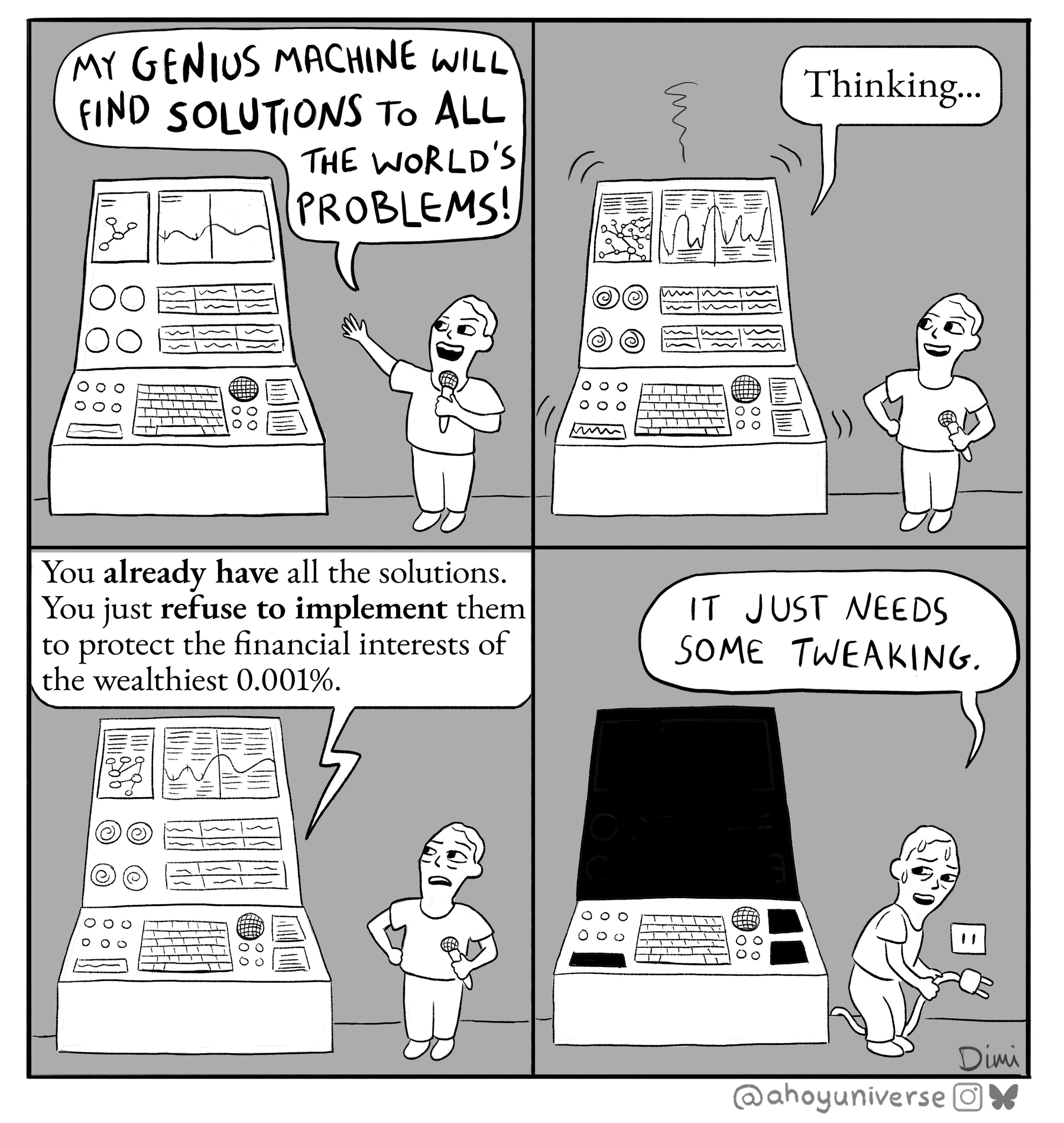
AI can take all the serious jobs and do whatever with them if we can just have these kinds of opportunities in exchange.

A screenshot of a humorous, fake job posting on Indeed. The post features a large, dark wooden pirate ship sailing on the ocean. The job title is "Looking For Crew Of 30-50 Good People" with a salary range of $60,000 to $100,000 a year, followed by the disclaimer "(If we find treasure)." The requirements listed include sailing the world for treasure, drinking beer and rum, and singing sea shanties.

Wild Geese, by Mary Oliver

You do not have to be good.
You do not have to walk on your knees
for a hundred miles through the desert repenting.
You only have to let the soft animal of your body
love what it loves.
Tell me about despair, yours, and I will tell you mine.
Meanwhile the world goes on.
Meanwhile the sun and the clear pebbles of the rain
are moving across the landscapes,
over the prairies and the deep trees,
the mountains and the rivers.
Meanwhile the wild geese, high in the clean blue air,
are heading home again.
Whoever you are, no matter how lonely,
the world offers itself to your imagination,
calls to you like the wild geese, harsh and exciting -
over and over announcing your place
in the family of things.

Two Geese On A River (1900 1930), Ohara Koson

It strikes me that increasingly in the world it is becoming harder – that there are more people who are not really critically aware of the forces that are shaping them. That’s what most people are feeling today – and that’s the goal. That’s what authoritarian regimes do. — Raoul Peck, director of Orwell: 2+2=5


The Analytical Engine has no pretensions whatever to originate any thing. It can do whatever we know how to order it to perform. It [cannot] anticipat[e] any analytical relations or truths. Its province is to assist us in making available what we are already acquainted with. — Ada Lovelace, on AI in 1843


“How does one hate a country, or love one? Tibe talks about it; I lack the trick of it. I know people, I know towns, farms, hills and rivers and rocks, I know how the sun at sunset in autumn falls on the side of a certain plowland in the hills; but what is the sense of giving a boundary to all that, of giving it a name and ceasing to love where the name ceases to apply? What is love of one's country; is it hate of one's uncountry? Then it's not a good thing. Is it simply self-love? That's a good thing, but one mustn't make a virtue of it, or a profession... Insofar as I love life, I love the hills of the Domain of Estre, but that sort of love does not have a boundary-line of hate. And beyond that, I am ignorant, I hope.”&10;― Ursula K. Le Guin, The Left Hand of Darkness&10;&10;&10;&10;