
Something broke in Lusaka
Update:
Access Now has confirmed it was Chinese government pressure that led to the cancelation of next week’s RightsCon in Zambia.
- A statement to our community about why RightsCon 2026 will not take place in Zambia — Access Now
- The Chinese Government Just Got the World’s Largest Digital Rights Conference Canceled — Wired
Days before thousands of people were due to arrive in Zambia for Access Now’s RightsCon next week — activists, journalists, policymakers, technologists — the government pulled the plug. Not with a clear objection, but encrypted in the kind of bureaucratic nonsense-speak used to obscure what it’s actually about: “national values,” “national procedures,” “diplomatic protocols.” Lies. Except maybe the creepy “national values” part. More on that later.
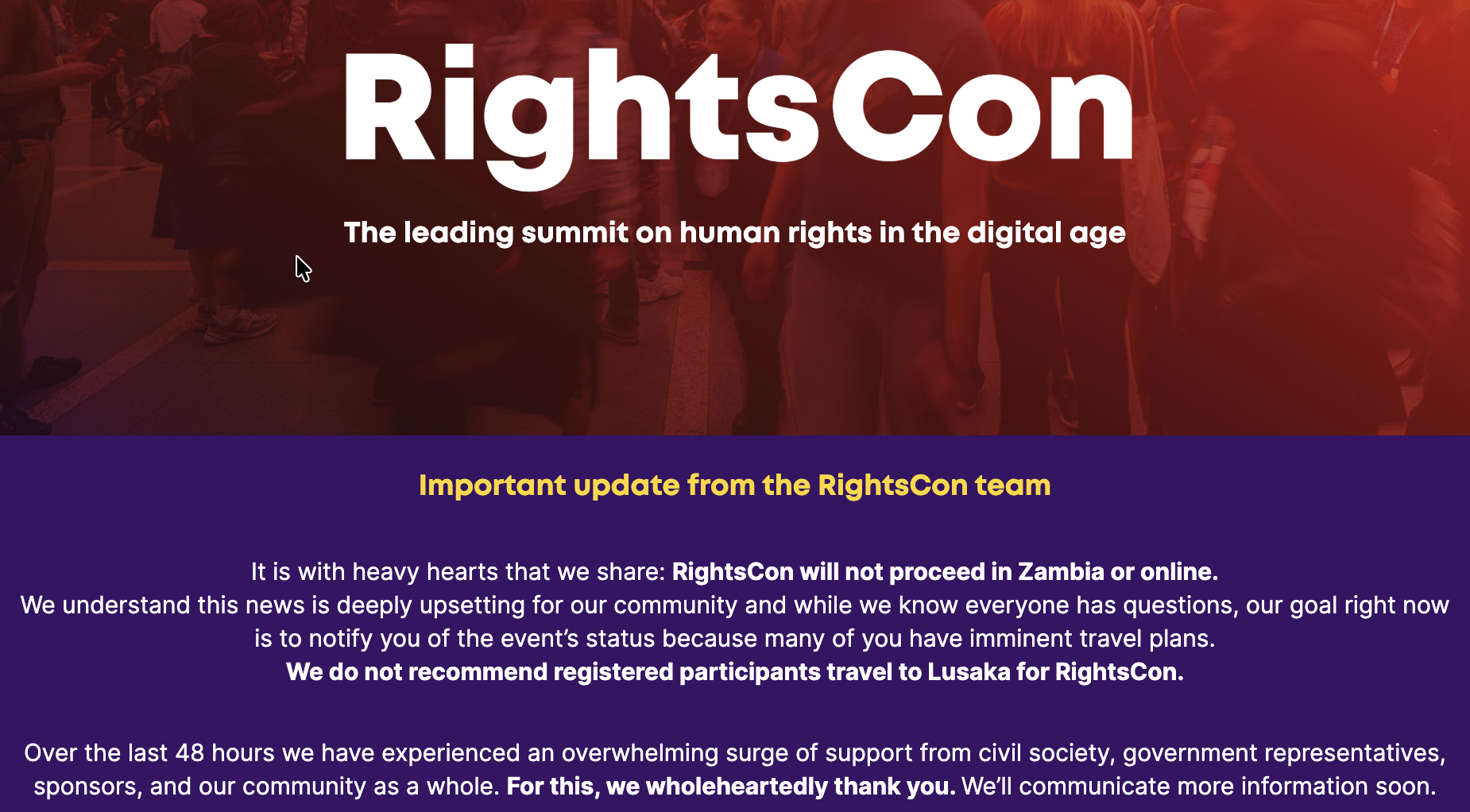
I wasn’t going, but was handling the FOMO. No funding, a usual state of being in the new reality. But I was in the forums, chat groups, and message threads, watching it assemble in real time… the meetings, the side conversations, the excitement about this rare moment when African civil society would be on the centre stage of the global conversation instead of having to orbit it. Then it all vanished.
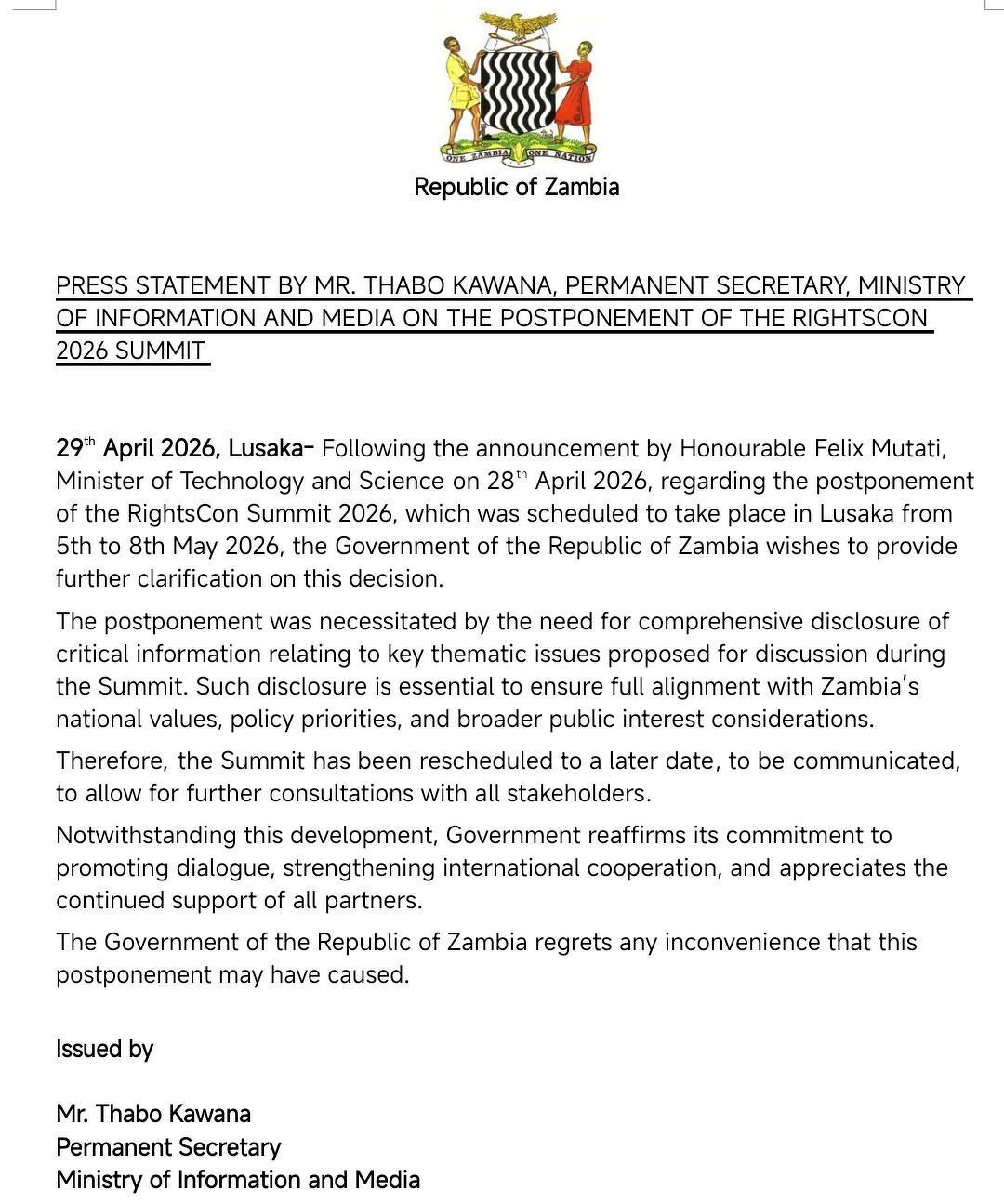
The explanation was first spotted on Facebook, as is the custom of our times. Then the confusion ensued. It was later followed up with an official statement by the government’s Minister of Technology and Science, written in the obfuscatory dross used when direct language would be too damaging. No specifics. No named concern. No concrete issue to resolve. Just a framework broad enough to contain anything and exclude everything. Topics can be misaligned. Speakers can lack clearance. It reads like process. It isn’t. This isn’t an explanation, it’s administrative opacity. It’s bureaucratic language providing cover for unmentionables. Difficult conversations can be filtered out before they happen this way.
We need to rethink how we gather. What collapsed in Lusaka wasn’t just a conference. It was a rare inversion.
Events like RightsCon deal with a contradiction. Hold them in what’s called the ‘global north’ and you exclude people who can most benefit. Blocked by visas, cost, distance, geopolitics. Move them to the ‘global south’ and you run into the systems they navigate every day: state pressure, corruption, surveillance, political control.
Zambia mattered because it briefly resolved that tension in the other direction. African digital rights and civil society organisations weren’t peripheral. They were central. That moment disappeared overnight. And like most things in this space, the loss isn’t evenly distributed. For some, it’s a cancelled trip. For others, it’s the removal of access, proximity, and visibility that rarely exists at this scale.
“Spaces like RightsCon 2026 are critical for communities who are already pushed to the margins, including sex workers, LGBTQIA+ people, and those seeking sexual and reproductive healthcare,” said Luca Stevenson of International Planned Parenthood Federation . “The cancellation disproportionately impacts those most affected by censorship, criminalisation, and digital exclusion. At a time when sex workers' voices are already suppressed online, losing one of the few global spaces to connect, organise, and advocate is deeply concerning.” — AllAfrica
To understand why, we just need to remember everything is always happening. A host country isn’t just a backdrop. Roughly $10 billion has flowed into Zambia’s mining sector in recent years. US-linked and Chinese firms are competing for control of copper, nickel, and cobalt.
While The US under Trump threatens Zambia with cutting support for HIV treatment if it doesn’t increase American access to minerals, Chinese financing (with several strings attached in other ways) runs through infrastructure, education, and energy. New bilateral agreements reinforce that relationship. At the same time, domestic pressure is tightening ahead of elections, with increased scrutiny of speech and digital policy.
“…well-placed sources have told News Diggers! that the [RightsCon] Summit has actually been cancelled because the programme involves Taiwanese delegates who would potentially speak against China at a venue donated by the Chinese government.”
When RightsCon was held in Taiwan last year, there was little China could do about the attendance of dissident Hong Kong groups or Uyghur human rights activists. When an event is going to be held in downtown Lusaka’s Mulungushi International Convention Center — a $60 million gift to Zambia from the Chinese government — there are people they can call if the agenda, some participants, or the event itself, is a little irksome.
Internet freedom wasn’t the only topic set for Lusaka next week. UNESCO is set to host World Press Freedom Day there the same week. It’s almost like an intensive schedule was set for May in some attempt to move up a notch on the V-Dem indices in a cram week or something. Here too, ideal hopes and material reality smack each other. That event is still going ahead. But the conditions around it have shifted. The Zambian government has introduced expanded registration requirements, requesting detailed information on attendees. Some journalists and organisations have already pulled out. Others have cancelled side events entirely.
An aside: Last year the Chinese Chamber of Commerce in Zambia hit the above mentioned Zambian investigative journalism outlet News Diggers with a SLAPP to block release of its documentary about environmental issues and working conditions at Chinese owned businesses in the country.
It’s not just that Zambia isn’t neutral ground for convenings like these. It’s that such ground has always been rare, and its declining faster than the climate. (These two things are not unrelated.) RightsCon has been amazingly resilient. It’s changed formats, locations, adapted through covid, pushed the envelope on accessibility and inclusion.
RightsCon isn’t just another conference. It’s one of the few remaining places where digital rights defenders, activists, journalists, technologists, lawyers, funders, and policymakers can find each other in the same room. It’s community infrastructure to build alliances, compare damage, trade tactics, share small victories, and remember that the work is not being done alone.
More than 5,000 people spent scarce funds, fought through visa systems, rearranged lives, and planned for months to be in Lusaka, many travelling from their own high-risk environments where visibility itself carries a cost. Zambia’s last-minute “postponement” is a cancellation in bureaucratic drag. It’s not just a logistical disruption; It is an attack on expression, association, and assembly, and a blunt demonstration of how brittle civic space has become. That it came from a government claiming the language of a global south voice and the pantomime of autonomy only makes the hypocrisy sharper, but this should not be seen as an aberration. It’s a signal.
My point — and I do have one — is that this moment demands more than solidarity statements. It calls for a genuine recalibration. The current models of building and sustaining human rights movements are failing. The new multi-polar hegemonic world is being carved up in different ways. This is evidenced in how much Internet Sovereignty has become the digital rhetorical device of our time, which I’ve banged on about already (here and here).
The Access Now team deserves enormous credit and gratitude for their tireless work each year to bring this space to communities that are too often excluded everywhere else. But this is a problem that can’t be left to one organisation. The movement, if there is to continue to be one, must decide how it reorganises for a more adversarial world, one where the act of coming together, already fraught, can’t be taken for granted.