
For 2026 I decided on some personal Bluesky glasnost to start the year. But there’re no free tools to open the floodgates. Blockenheimer used to do that as well as be a great blocking service, but I noticed it’s dead now. So I made a wee script for it: github.com/drew3000/…
Trump regime just ordered the the U.S. to withdraw from international agreements or work that “are contrary to the Interests of the United States.” Let’s look at what these include:
- climate / environment
- human rights / conflict prevention
- internet freedom / cyber security
- anti-corruption / legal
Insurrection is still a value-neutral term
Insurrection is not a pejorative word. It’s inherently value-neutral. Our opposition or support of one is based on two things: the system it opposes, and whatever it seeks to replace that system with. Given the right context, nearly everyone is for an insurrection somewhere.
Secure file sharing back on the new blog with OnionShare

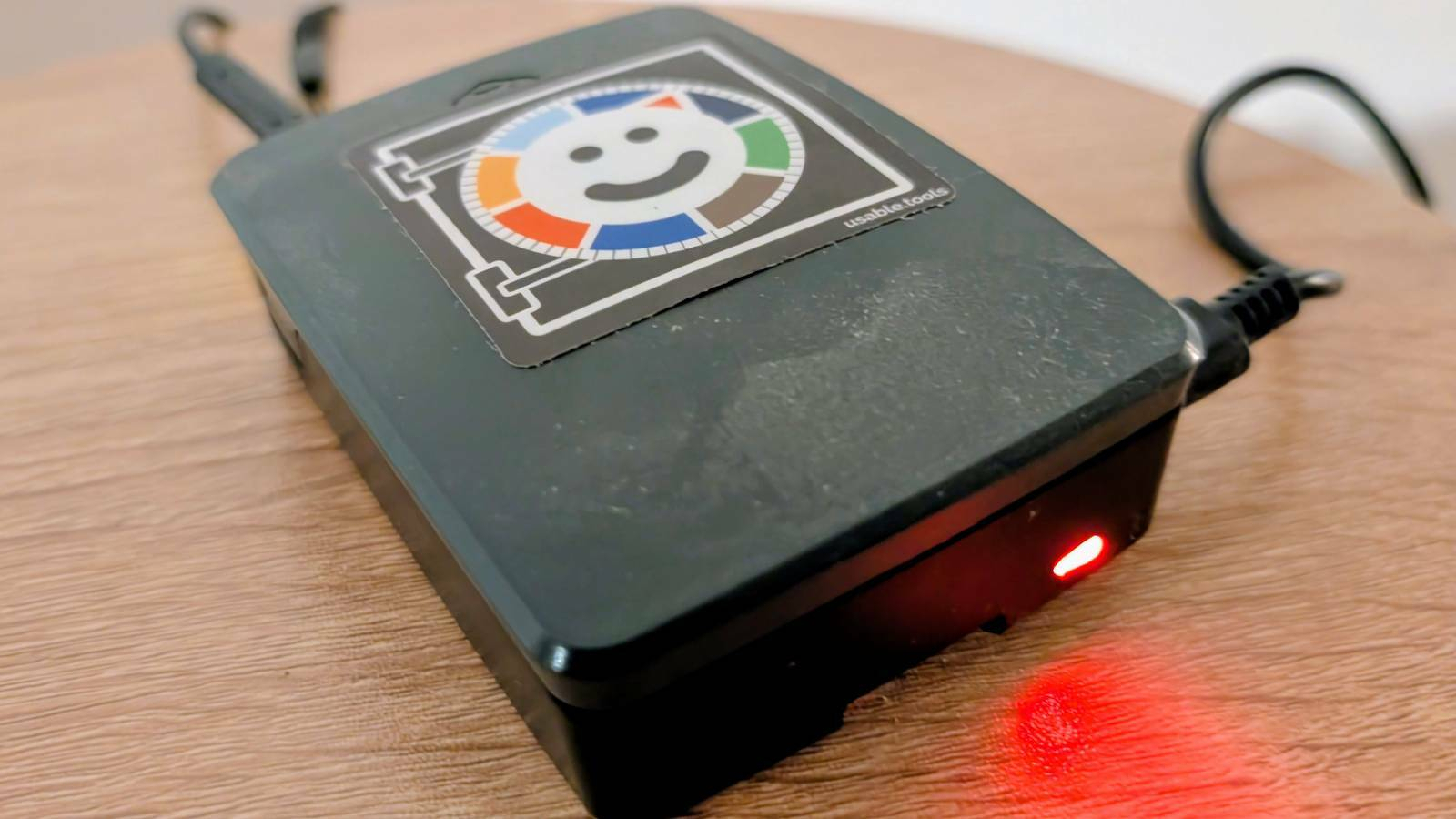
As one of my Twixmas projects I’ve decided to reboot my OnionShare site. It’s a secure and anonymous way for someone in the world to send files straight to a Raspberry Pi on my desk over the Tor network. I had it set up for a while two blog domains ago, and today decided it’s time to plug it all back in. In order to reach it you need to use the Tor Browser, and with it visit:
http://entyms3fdn4fyl6lizog6hoztvaqkvv2njmcovslkm55xhahs7nnmiqd.onion
OnionShare was developed by Micah Lee, a programmer who develops spiffy open source privacy and security tools for journalists to better work with whistle blowers and hacked or leaked files. You can find out more about it, and other potentially useful programs at Lockdown Systems.
Larger news organisations can operate super locked-down and managed whistle blowing platforms like SecureDrop or GlobaLeaks. OnionShare is a nice, reasonably secure option for small outfits, freelance journalists or others. I’m operating a persistent (always on) version, but its most common use case is an app that someone can fire up when it’s needed and then shut it off when it isn’t.
I posted a Github Gist about how I’m running it. There are threat models around using these kinds of tools, and then the whole workflow of handling files that may or may not be malicious. Will get into it in other posts. Watch this space.
Watched: Hedda 🍿
It’s a well done adaptation from stage to screen in a sort of alternating fever dream / nightmare set of sequences, each more chaotic than the last. Great to see Tessa Thompson lead a dramatic film after so many (entertaining) sci-fi action movies.
Situations wanted
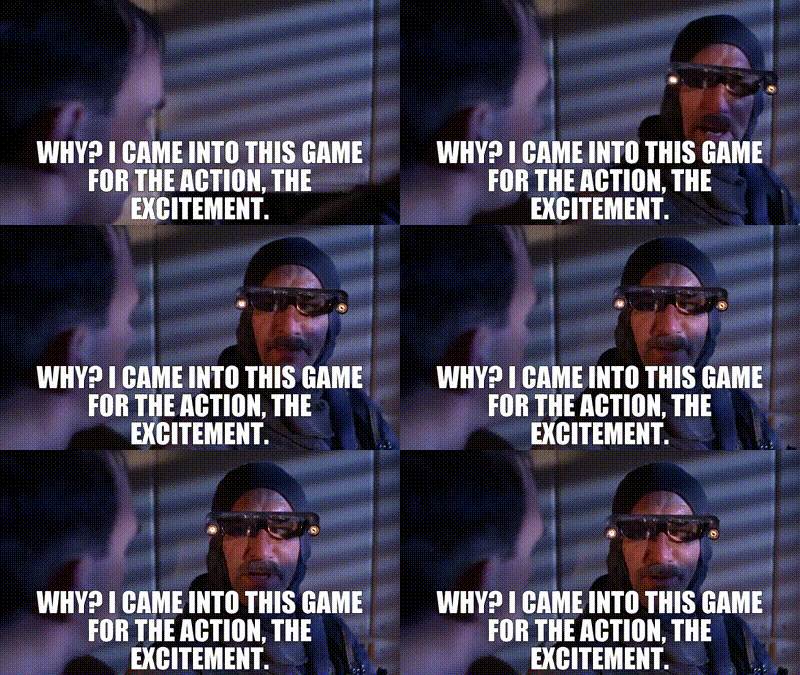
In my headcannon, I’ve been trying to model my career, to the extent that’s possible, after one of my favourite sci-fi action heroes. You know the one I mean, of course. Yep! Archibald “Harry” Tuttle, the outlaw plumber in the dystopian bureaucracypunk film Brazil.
Yes, I’ve just coined “bureaucracypunk.” It’s soon to be part of the cultural zeitgeist of our times. Adminpunk may be a shorter, snappier alternative, but it doesn’t quite get to the point of what it is. Kafka’s The Trial would be a kind of proto-bureaucracypunk. Other classics of my genre would be Office Space, The Death of Stalin, or possibly the series Severance. Roll with it.
Harry’s only got 15 minutes in Terry Gilliam’s two-and-a-half-hour film about the tyranny of the administrative layer. He monitors radio waves for signs of distress calls to Central Services from people whose heating or air conditioning is on the fritz, breaks into their flats to repair a thermostat or reroute a sewage line, and then rappels away into the night. Awesome. 2026 may be the year for it.Anyway…
This blog post is a longer version of the already too-long post I published on LinkedIn. That site generously gives you 2,000 characters to shoot your shot. But if you can’t plagiarise yourself on your other platforms, then what good is having any of them?
I changed my LinkedIn profile to light the green #OpenToWork beacon a week before Christmas. It may have been a year in the making. Like many others working across the NGO world (in media development and beyond), the funding cuts domino effect started by the Trump administration in the U.S. in January has continued to ripple around the globe, reaching me in December. The world is changing (an understatement). As a result, the work I’ve been doing feels more pressing now than ever. The challenge for 2026 will be finding new ways to continue working in these areas, and discovering what shape this work can take.
For the last 10+ years at Internews, I developed, scaled, and led the Global Technology Hub (GTH), an internationally distributed unit of multi-disciplinary technologists providing direct assistance to media, human rights, and civil society groups worldwide. GTH focused on digital safety, secure communications and infrastructure, censorship circumvention, and sustainable organisational resilience through hands-on support, incident response, and long-term capacity building. It worked with hundreds of organisations across nearly 40 countries to help them stay online, operate securely, communicate privately, access an uncensored web or deal with an internet shutdown, and keep working under pressure from war, regime change, creeping autocracy, or entrenched authoritarianism.
Nothing in world events suggests that need has gone away.
Back in June, Internews, in collaboration with a consortia of media development organisations, released Crisis in Journalism: The Impact of the US Government Funding Cuts on Global Media, which examined the consequences of eliminating $150 million in annual support for journalism worldwide. The report catalogued the immediate consequences: the media outlet closures, widespread staff reductions, and the overall global damage to public interest journalism among them. It also touched on how journalists face increasingly tougher digital security risks at a very time when these cuts have also reduced their access to the technical support systems and expertise needed to deal with them.
Media support and internet freedom work have always been fellow travellers. The internet isn’t as useful without good, fact-based news and information, and that information isn’t as available without a securely accessible, open internet. 2025 has seen serious setbacks to both. It has been several months since January — when the U.S. government rapidly shuttered its foreign assistance programmes, including those that had for decades supported diverse, independent media efforts globally as well as numerous vital internet freedom and technology initiatives — and the damage is still unfolding.
This halt in foreign aid funding for technology initiatives that support online access, digital safety, privacy and other internet freedom needs damaged not only news gathering organisations, of course. It affected civil society organisations more broadly, as well. These CSOs also provide locally relevant information. They tackle environmental issues, do humanitarian work, support gender rights, promote civic engagement, human rights, etc., and aim to hold power to account. It cut funding to their budgets, sure. But beyond that it also hit the projects and organisations that develop the tools they use to circumvent censorship or surveillance, communicate securely, and even publish their work. It reduced access to the expertise they rely on to mitigate the chances of an attack, or to recover after one."
These cuts have had cascading effects," reported the TechGlobal Institute in its impact analysis. “legal aid for persecuted journalists has dwindled, digital safety training for activists has been reduced, and critical network interference monitoring efforts have been abandoned. This crisis has left tens of thousands of pro-democracy advocates, civil society groups, and whistleblowers without essential digital protections at a time when online repression is intensifying. One survey respondent reported that over 5,000 indirect beneficiaries have already been impacted by the funding shortfall.”
“Across the sector, organizations are not only losing the people whose expertise helps them prepare for digital attacks, but also the services and hardware they need to protect themselves and their work,” stated Access Now in its own assessment. “Meanwhile, some digital security help desks that relied on U.S. funding to assist civil society are shutting down completely, while others are having to cut services and staff to survive, leaving civil society partners and peers without access to external expert support. Ultimately, this undermines activists’ ability to organize and challenge people in power, journalists’ efforts to expose the truth, and whistleblowers’ work to document and expose human rights violations.”
At Internews, U.S.-funded, groundbreaking digital safety initiatives and programming were brought to an almost complete halt. Any digital security or support services to media organisations falling under those funds were also rapidly cut, leaving many media organisations around the world in a tougher situation. Central to this was the Civic Defenders Initiative. This was to carry on the work of the Greater Internet Freedom (GIF) Project, the largest global effort of its kind, working across 39 countries to support locally relevant digital security trainings and assistance mechanisms for civil society and media, and increased citizen engagement in internet governance. Across regions around the globe, the necessary groundwork that these programmes had started has been damaged, and multiple systems of support for at-risk communities have had to close or severely scale back their operations.
This trend is still unfolding today. In November I went to The Communication and Media Research Institute (CAMRI)’s workshop future of media development. The impact has been “especially acute in places like Syria (Radio Rozana), Uganda, Cuba, and the Western Balkans. Investigative units in Latin America have folded. Local actors are stepping up—regional funds, civic tech, and journalist networks—but they operate with limited resources. Meanwhile, authoritarian actors are rushing in to fill the void—offering funding, narrative dominance, and repression.” I would add the U.S. to that group, having pivoted from being a problematic ally to being an increasing threat.
Over in my GTH corner of it all, I was privileged to work alongside an exceptional group of engineers, developers, trainers, incident responders, and security specialists, and to learn from them every day, while collaborating at the intersection of technology, security, and human rights with a wider ecosystem of support initiatives through the Journalists in Distress Network, NGO-ISAC, CiviCERT, the Journalism Cloud Alliance, and many others. That work shaped how I think about this field and where I want to contribute next. As the CAMRI event asked: “If the golden era of donor-funded media development has ended—what now?”
And so, if you’re hiring, building something new, or just want to compare notes on where this space is heading, I’d welcome the conversation. If you know others navigating similar transitions, feel free to point them my way too. I’m always happy to grab a coffee online, or in person if you happen to be in London. And if I can’t help directly, I’ve got a reasonably good roster of contacts who might.
My work has spanned strategy and direct delivery, from leading teams and managing programmes to hands-on technical work, service design, platform development, fundraising, and building the operational, governance, and learning systems needed to sustain the work at any scale. What I do, and what I’m interested in, can broadly fit into these areas:
- Cybersecurity and digital resilience: organisational security, incident response, risk, governance, and operating under pressure.
- Leadership of global teams and programmes: building services, processes, and teams that work across borders and contexts.
- Bridging technical, policy, and organisational worlds: translating between engineers, leadership, legal, funders, platforms, and other partners.
- Advising on and developing new models and methods for digital resilience: shaping strategies, services, tools, or organisations from early concept through launch and beyond.
- Exploring what comes next: open to conversations about roles, projects, collaborations, or ideas where any of my background could be helpful.
And there it is. Thanks for scrolling this far. I’m looking at roles, advisory work, or projects where my experience, skills or, expertise can be useful. In particular, I’m keen to continue supporting media, civil society, and others operating under various kinds of challenges, in whatever shape that work takes next. Drop me a line and say hey.
AP reports that files are going missing from the DOJ Epstein Files archive, and now I see on social platforms multiple accounts promising to have zip files of the ‘complete’ archive you can download (no, there are no previews) and, well, this is a super great way to get malware. Don’t do that.
'The strawberry is dead.'
Some things on the regular doom scroll can still give me pause. Not because they’re particularly horrible, or somehow hastening my own desensitisation to every turn of the screw in the decline of liberal democracies around the world. I’m used to that. But it’s the occasional lone voice or appeal from one of the decks of the sinking ship that just stands out. In this case it was a TikTok video of a BBC science show presenter who was tired of being told to keep quiet about things that have no bearing on his ability to educate or entertain.
On Friday evening in Manchester, the audience at a live recording of Radio 4’s The Infinite Monkey Cage heard something they were not expecting. They heard an ending. Not of the show. Not yet. Series 35 is still set to broadcast early next year. Should it continue afterwards, it just won’t be with Robin Ince. After 16 years of co-hosting the show he named and developed with Professor Brian Cox, the comedian is out. There is no punch line here. Just a punch to the gut.
Instead of repeating what he said, here’s the video. You can get it first hand.
This kind of departure will become more common. It rarely happens with a formal dismissal. It begins with pressure. Quiet meetings. Warnings about tone and conduct. Requests to be careful, to be quieter, to keep certain views out of sight. In this case, Ince was asked to self censor about his support for trans people, his criticism of Donald Trump, and other views that were deemed to somehow be incompatible with his role as the comedy relief portion of an educational radio programme. Considering the U.S. has leadership that regularly dismisses science whether it’s about vaccines or climate change, it would seem to me that Ince has been remarkably well behaved. Just not enough for the BBC.
He was offered a choice: Obedience, or departure. He chose to leave. It hasn’t been the first, and it won’t be the last.
This moment does not stand alone. It arrives after sustained pressure on the BBC, particularly from the U.S. president as of late. Loaded allegations of bias from the White House have been amplified by the right wing publications in the UK, and a noticeable lack of comment by the government here. The same “impartial” memo cited by the Trump White House to accuse a BBC Panorama documentary of fabricating that Trump’s own words may have encouraged the Capitol Hill riots of January 6, 2021 (it didn’t) had more to say: It accused (without basis) the BBC’s Arabic service of showing systemic anti-Israel bias in its coverage of the war in Gaza. It also alleged that the BBC was promoting a pro-trans agenda.
Robin Ince would not recognise that characterisation. Neither would Gary Lineker, the long-standing Match of the Day presenter, who was forced out of his role over his views against Israel’s war crimes and acts of genocide in Gaza. Not even the recently resigned director general Tim Davie should agree with this characterisation, having personally stepped in to suppress the documentary, Gaza: Doctors Under Attack. The 100 BBC staff who signed a letter alleging the public broadcaster had constantly given “favourable coverage to Israel” certainly would have a different take.
This memo on BBC’s supposed leftwing bias seems to have been written to be leaked, and that would make sense. Its author is the lobbyist, Michael Prescott, whose company receives large sums of cash from technology and media giants in the U.S. who are also on the Trump campaign’s large donor list.
It was money well spent.
The language was familiar. So was the intent. Discredit the institution. Intimidate the people who work within it. Force conformity through fear. It’s working. This isn’t censorship by law. It’s something quieter, more corrosive. It asks individuals to narrow themselves to survive. It rewards conformity with the chorus, tolerates silence, and punishes empathy when it becomes inconvenient or is aimed at the wrong people.
I kept thinking about all the extremist voices promoting hate and division. They are being given so many platforms, while voices that represent kindness, open mindedness, empathy seem to be scarcer and scarcer. I felt I couldn’t pamper myself with the luxury of silence.
— Robin Ince
Institutions do not collapse all at once. They are hollowed out. They lose the people who give them texture and trust. When presenters, editors, and producers conclude that honesty carries too high a price, the public is left with something thinner. Something that can seem safer, but is in substance less reliable. Something less true.
The BBC will continue, for now. The programme may or may not resume after season 35. But there’s been a signal. A warning about the cost of speaking plainly in an age that claims to value openness while punishing those who practise it. In his own words, spoken to his audience on his final night, Ince explained why he could not stay: “I have to accept that I am not what the current BBC expects of their freelance presenters.”
McCarthyism is back in vogue, and it’s increasingly globalised. We have to wonder, how much editorial policy of the nation’s public broadcaster should be outsourced to American political circles across the Atlantic? These are “meet the moment” times, and we’ve already seen a lot of them go unmet. Eventually, the clock runs out of them.
“The strawberry is dead. Long live the strawberry."
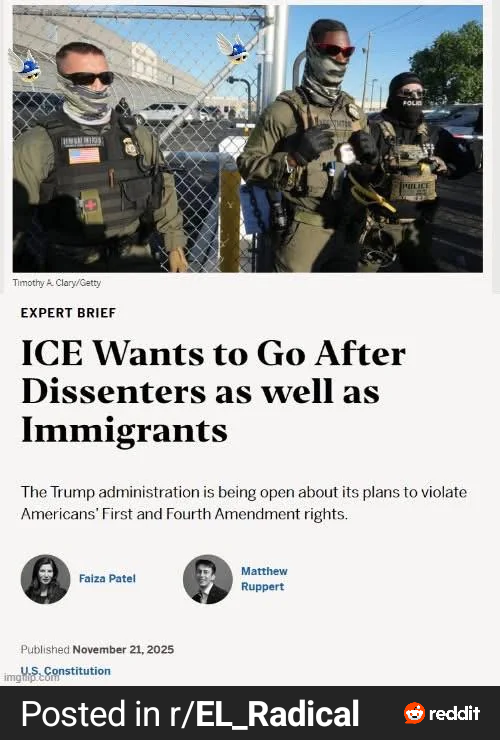
“U.S. Immigration and Customs Enforcement has embarked on a spending spree, signing contracts worth up to $25 million for a smorgasbord of spy technology: social media monitoring systems, cellphone location tracking, facial recognition, remote hacking tools, and more.” ….
“What’s new is that the federal government now openly says it will use its supercharged spy capabilities to target people who oppose ICE’s actions.”
— The Brennan Center for Justice at NYU Law
Notes on the Palestine Action proscription appeal
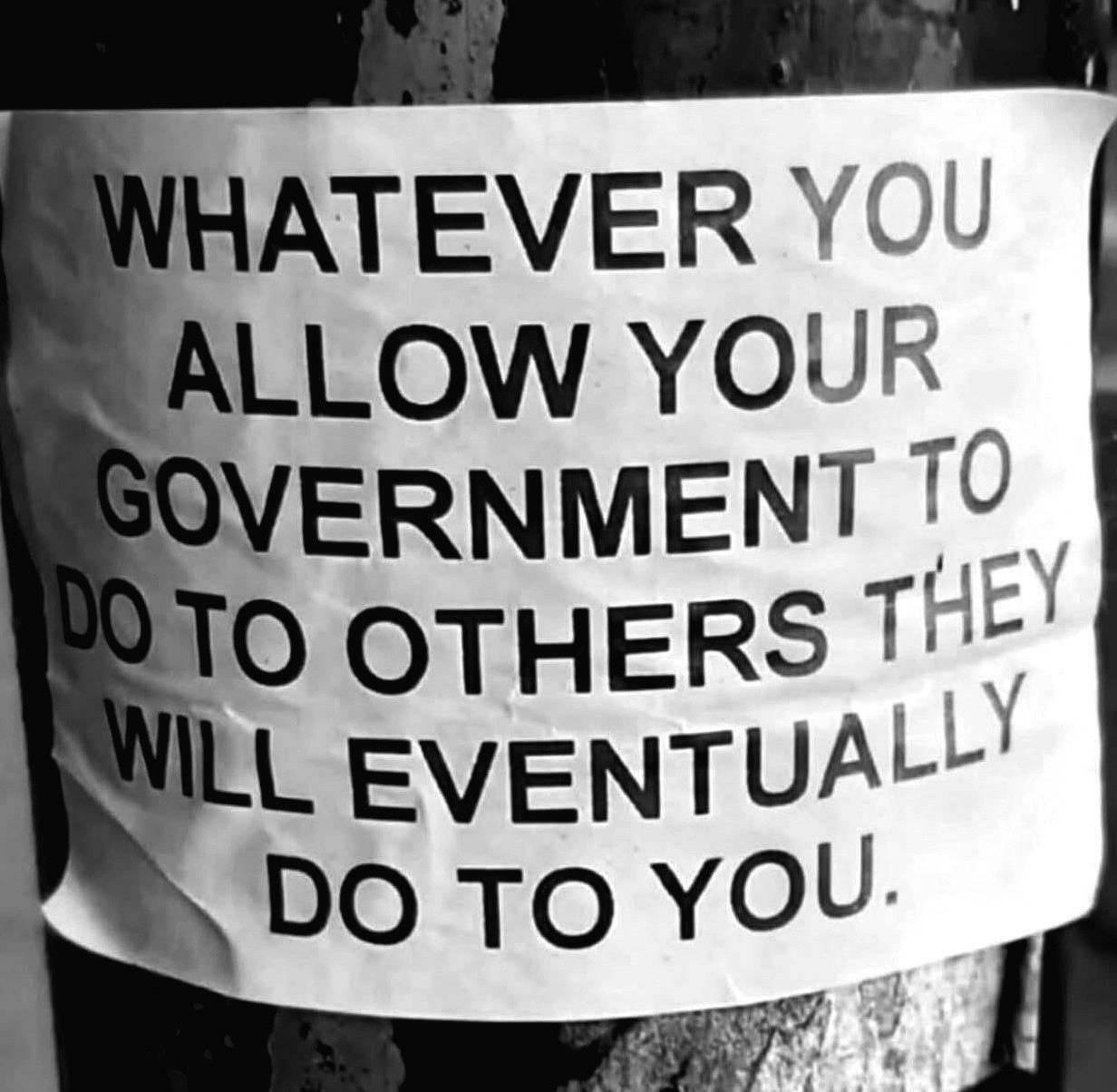
Amnesty UK and Liberty joined the judicial review challenging Keir Starmer’s Labour Government’s nonsense proscription of Palestine Action, which would designate a nonviolent protest group populated by a mix of British citizens — such as a daughter of a Holocaust survivor, a blind man in a wheelchair, and several hundred people with more in common with your gran — as being exactly the same as Al Qaeda.
The arrest of peaceful protestors is a violation of the UK’s international obligations to protect the rights of freedom of expression and peaceful assembly. This can’t go unchallenged."
— Amnesty UK
It was a silly, reactionary decision by this government, embarrassed by the fact that a small, informal group of activists were able to casually ride some e-scooters onto an air base with seemingly no security and daub a bit of paint on some planes. But it’s what happens when we have a prime minister who takes his marching orders from Trump’s White House.
This is essentially a question over whether UK has all the facets needed for a participatory liberal democracy or not. Supporting Palestinian liberation is how you test the health of your own liberty, it seems. If this Labour government fails to uphold the designation, then it’s a calamitous embarrassment for Keir. If it’s able to win, then Labour will have damaged to the country. Take your pick.

“We’ve arranged a global civilization in which most crucial elements profoundly depend on science and technology. We have also arranged things so that almost no one understands science and technology. This is a prescription for disaster. We might get away with it for a while, but sooner or later this combustible mixture of ignorance and power is going to blow up in our faces.”
— Carl Sagan
Note: I’m reading The Demon-Haunted World: Science as a Candle in the Dark, and I’m futzing with the blockquote css on this website so wanted a test quote to experiment with on main.
The best doom reports from 2025
This was the year of Project 2025, a sort of dystopian teaser of coming attractions once the MAGA regime moved back into the White House after the Biden administration retired. It was published in 2023 by the Heritage Foundation during the intermission between Trump sagas when one could suppose they had some time to kill, and was sort of a New Year’s Resolution shitty things the far right could get on with when it inevitably got back into position this year. And, say what you will, they haven’t been slackers. The Project 2025 Tracker estimates overall progress of dismantling liberal democracy in the U.S. is at 48%. In just the first year!
It’s only the middle of November, but I’m calling time with a list of the best (worst?) of the doom reports I’ve doom scrolled. If you, like me, are drawn to well structured and sourced reporting on The Situation as it is with your Saturday morning coffee, then you may have seen a few of these already. They’re my picks of the crème de la crème of dark reading from the year: covering the slow, grinding collapse of democracy, the fragmenting and increasingly closed, monitored or pay-walled internet, and irreversible damage to our favourite punching bag: the climate… Enjoy.
The Authoritarian Stack — Here’s how tech billionaires are designing the post-democratic America, and what’s coming for Europe in the coming years. It’s a grim, well-researched roadmap for how a handful of oligarchs are constructing parallel governance architectures nobody voted for. (A project led by Prof. Francesca Bria with xof-research.org)
Digital sovereignty or digital dictatorship? — It’s hard to imagine how things can get worse, and you don’t have to because the Kremlin is already on the job, mixing technological isolationism, intimidation tactics and regulatory hellscapes that make more people just want to shut up, leaving the state free to just get on with more war crimes in Ukraine. (New Eurasian Strategy Centre)
The 2025 Global Report of the Lancet Countdown — The people of earth have decided to double down on fossil fuels, ignore the 546,000 heat-related deaths and direct our efforts toward raising the transmission potential of dengue. Huge accomplishments. This report contains a fun scrollable summary of how we’re causing our own demise. (The Lancet Countdown)
The Internet Coup — This is detailed technical analysis and nightmare material about how a Chinese company (Geedge) is exporting components of the Great Firewall to its autocratic friends and neighbours need of a helping hand. It’s working disturbingly well. (InterSecLab)
Mythical Beasts: Diving into the depths of the global spyware market — I will forgive the Potterverse reference for this one. It’s harder than you’d think to make people care about the global spyware industry that’s targeting the world’s journalists, human rights defenders, environmental activists and opponents to despots and autocrats. This one features a neat interactive map connecting the dots between 435 companies and other organisational entities across 42 countries that make up the distributed panopticon of oppressive fuckery. (The Atlantic Council)
The Global Assessment Report on Disaster Risk Reduction — Disasters are no longer “acts of god” (always found that phrase odd) but rather an act of self-harm that humans do to themselves as a matter of course. While this one tries to put a positive spin on things with sections like a “hazardous future is not inevitable,” yeah it kind of is. All the solutions require everyone going along. Until the planet is essentially experiencing the story line of Pluribus, everybody never goes along. This report is neat in how it identifies three spiring conditions of doom that underpin our current shitshow, all of them economic:
- Increasing debt and decreasing income that leave a majority of national economies fucked and unable to invest in ‘going green’
- An unsustainable transfer of risk to the countries that are more intensely hit by the effects of global warming, meaning they’re spending more money on disaster related risk and less on intervention or mitigation.
- The respond-repeat cycle of disaster relief and humanitarian aid that has zero impact on sustained recovery let alone prevention.
We could fix this issue, sure. Easy. It minimally requires changing how we’ve evolved as a species to respond to literally everything. But I digress. Ignore me, it’ll be fine. Enjoy today, be kind to people around you. (UN Office of Disaster Risk Reduction)
V-Dem Democracy Report 2025 — Democracy worldwide has regressed to mid-1980s levels but without the synth pop sound track and fashion trend that included far too many zippers. More people are now living under autocracies than democracies. Freedom of expression continues its slide. Essentially an autopsy of global liberalism. (V-Dem)
Freedom on the Net 2025 — The fifteenth straight year of global decline. Details the rise of “sovereign AI” censorship systems and increasingly militarised national internets. Information may in fact “want to be free” but its increasingly traveling along infrastructure controlled by states that have other ideas. (Freedom House)
CIVICUS State of Civil Society Report 2025 — Civil society is being sucker punched from every direction. This one contains a particularly bleak technology chapter around biometric surveillance, emotional-recognition systems (smile, don’t stop smiling), private-sector repression, and billionaire politics that continue their trend of just saying quiet parts out load around authoritarianism and other horrible beliefs. (CIVICUS)
International AI Safety Report (2025) — The first of its kind, lengthy, in-depth, nuanced, comprehensive, authoritative, contributed to by 100+ experts in their fields across 30 countries, and likely to be absolutely ignored by the government that commissioned it. While it has those boo-scary nods to how an AI might “misbehave,” there’s more on how it could perform very well as intended to help users with cyberwar efforts, develop bioweapons, further concentrate power, build smarter surveillance tools, peddle disinformation, build autonomous weapons, and just keep disrupting global systems in evermore destabilising ways. It’s got a lot of the elements of a Michael Crichton novel and none of the readability. (Commissioned by UK Government, led by Professor Yoshua Bengio)
How Malicious AI Swarms Can Threaten Democracy: The Fusion of Agentic AI and LLMs Marks a New Frontier in Information Warfare — Here is a fun one. This is an academic study outlining how coordinated AI agents could overwhelm information ecosystems, fabricate synthetic consensus, and destabilise institutions. A glimpse into a Fully Automated Luxury Disinformation future, except it’s already here. (citations: arXiv:2506.06299)
And that’s my list for 2025. Leave me a reply if you’ve got one or two that should be in the list.
In every book or article or show on how bad some existential threat is, there’s always that last section that I’ll call the “there’s still time” PSA. Every author who writes about climate change has an agent begging them to tack on a hopeful last chapter. Many of the reports linked to above have one of those sections as well. Comforting. Until I have agent representation I’ll spare you from the needless extra words, dear reader.
“Good night, and good luck."
(Testing a youtube embedding plugin. Here is the video for where it’s not embedding.)
Personal assistant oriented agentic AI is offering a convenience business proposition to create highly scaled MiTM attack vectors and surveillance opportunities.
“I have a foreboding of an America in my children’s or grandchildren’s time — when the United States is a service and information economy; when nearly all the manufacturing industries have slipped away to other countries; when awesome technological powers are in the hands of a very few, and no one representing the public interest can even grasp the issues; when the people have lost the ability to set their own agendas or knowledgeably question those in authority; when, clutching our crystals and nervously consulting our horoscopes, our critical faculties in decline, unable to distinguish between what feels good and what’s true, we slide, almost without noticing, back into superstition and darkness…” — Carl Sagan, The Demon-Haunted World: Science as a Candle in the Dark (1995)
It sounds eerily familiar. He was 62 when he wrote it, dying from myelodysplasia, having had spent a life popularising science through the Cosmos TV series and books like ‘Pale Blue Dot.’ He wasn’t afraid of death, but of what was happening to America. He never saw smartphones, the rise of social media, Q Anon, COVID conspiracy theories, or AI slop. But he saw enough.
American sanctions are being used to memory hole Israeli war crimes: we need new platform stacks asap
YouTube wiped over 700 videos from its platform documenting Israeli human rights abuses from accounts run by the Al Mezan Center for Human Rights, Al-Haq, and the Palestinian Centre for Human Rights. This was due to the U.S. weaponising its sanctions regime against Palestinian rights groups.

The Intercept reported (linked above) that “the deleted videos range in scope from investigations, such as an analysis of the Israeli killing of American journalist Shireen Abu Akleh, to testimonies of Palestinians tortured by Israeli forces and documentaries like The Beach,' about children playing on a beach who were killed by an Israeli strike.”
While Youtube caved in fast, it’s harder to wipe everything off the internet than some (zionists) would like, and a number of the videos remain scattered across the Internet Archive’s Wayback Machine, Facebook pages, Vimeo, etc, but the damage is real. Several were only online via Youtube and each organisation’s channels represented complete online repositories accessible in one place, authenticated and easily accessed.
“I’m pretty shocked that YouTube is showing such a little backbone. It’s really hard to imagine any serious argument that sharing information from these Palestinian human rights organizations would somehow violate sanctions. Succumbing to this arbitrary designation of these Palestinian organizations, to now censor them, is disappointing and pretty surprising. … They are basically allowing the Trump administration to dictate what information they share with the global audience. It’s not going to end with Palestine.” — Sarah Leah Whitson, executive director of Democracy for the Arab World Now (DAWN)
Whitson may be shocked, but I’m not. Waiting for corporate tech to grow a spine when there’s not a clear profit motive to do so is akin to waiting for a bus you already know will never show up.
I’m a fan of the alternative platforms, particularly those running on decentralised systems. Media files can practically become like weeds on these given enough resources. Peertube, Torrent streamers, and so on exist. We can do a lot at the protocol level, but the protocol that’s really needed is chutzpah. It’s in really short supply these days. Building censorship resistant tools needs it. Depending on where you are, using them takes a little. Resisting illegal orders from powerful state agencies requires it.
There’s irony in this, as the U.S. tries to use sanctions to silence Palestinian human rights organisations, it’s threatening sanctions against the EU over its Digital Services Act, which the White House is concerned will silence “American conservatives” (this is not what the White House is really angry about and it doesn’t do that anyway). More and more, the concept of a free and open internet is on the back foot in various halls of power around the globe, and a few Big Tech companies are kind of excited by the business opportunities in shutting things down. Russia has its concept of ‘digital sovereignty’, China has its exportable firewall technology, America has sanctions. The results are the same: expanding control. We need ways and means that circumvent them all. The dumbest move is to appease any of them.
It’s not going to end with Palestine.
Long been a listener of the This is Not a Drill podcast, but Gavin Esler’s interview this week with Bruce Schneier, in “Big Tech, A.I. and the dictators – Inside the future of authoritarianism” is maybe one of the best episodes I’ve caught. It has the spoilers about how democracy ends. Enjoy.
Individuals associated with the federal government have, in defiance of a court order and without a trial or any form of due process, deported hundreds of people from the territory of the United States to El Salvador, where they will be held indefinitely in a concentration camp. — Timothy Snyder
The White House is currently transitioning the U.S. Constitution into a relic, replacing it with whatever the whims of the sitting administration demand on the day.
Hello yet again, cruel world
It’s a brand new blog on a new publishing platform. The jokes, however, are old.