Situations wanted
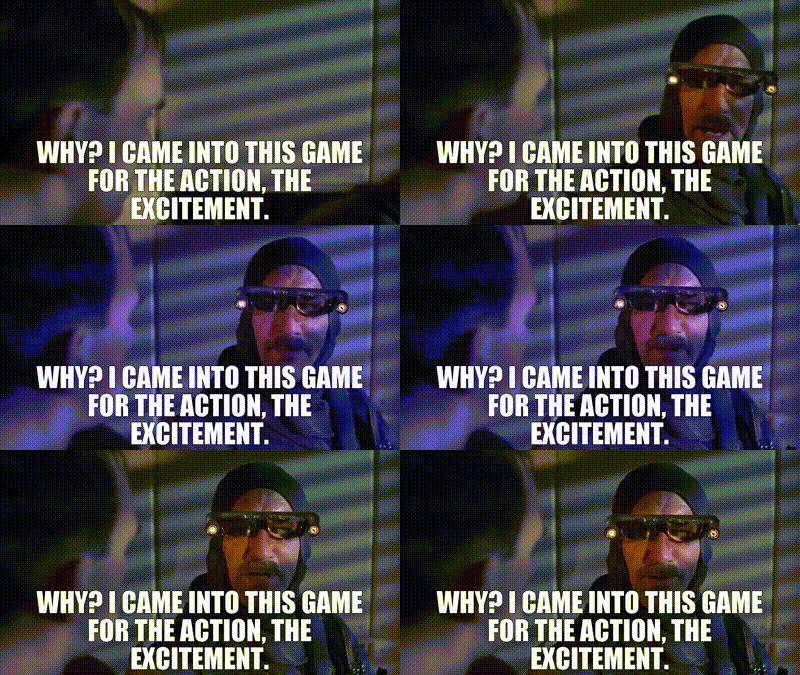
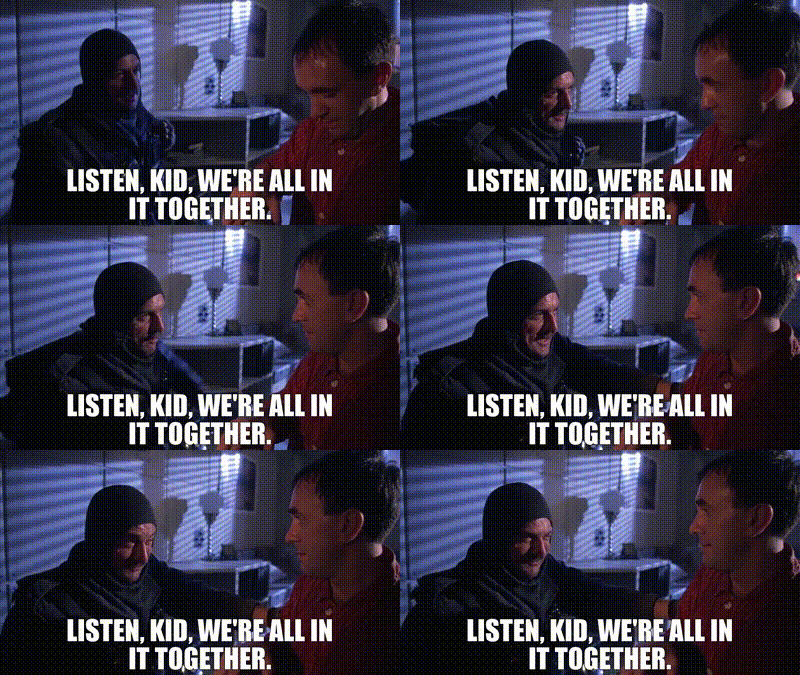
In my headcannon, I’ve been trying to model my career, to the extent that’s possible, after one of my favourite sci-fi action heroes. You know the one I mean, of course. Yep! Archibald “Harry” Tuttle, the outlaw plumber in the dystopian bureaucracypunk film Brazil.
Yes, I’ve just coined “bureaucracypunk.” It’s soon to be part of the cultural zeitgeist of our times. Adminpunk may be a shorter, snappier alternative, but it doesn’t quite get to the point of what it is. Kafka’s The Trial would be a kind of proto-bureaucracypunk. Other classics of my genre would be Office Space, The Death of Stalin, or possibly the series Severance. Roll with it.
Harry’s only got 15 minutes in Terry Gilliam’s two-and-a-half-hour film about the tyranny of the administrative layer. He monitors radio waves for signs of distress calls to Central Services from people whose heating or air conditioning is on the fritz, breaks into their flats to repair a thermostat or reroute a sewage line, and then rappels away into the night. Awesome. 2026 may be the year for it.Anyway…
This blog post is a longer version of the already too-long post I published on LinkedIn. That site generously gives you 2,000 characters to shoot your shot. But if you can’t plagiarise yourself on your other platforms, then what good is having any of them?
I changed my LinkedIn profile to light the green #OpenToWork beacon a week before Christmas. It may have been a year in the making. Like many others working across the NGO world (in media development and beyond), the funding cuts domino effect started by the Trump administration in the U.S. in January has continued to ripple around the globe, reaching me in December. The world is changing (an understatement). As a result, the work I’ve been doing feels more pressing now than ever. The challenge for 2026 will be finding new ways to continue working in these areas, and discovering what shape this work can take.
For the last 10+ years at Internews, I developed, scaled, and led the Global Technology Hub (GTH), an internationally distributed unit of multi-disciplinary technologists providing direct assistance to media, human rights, and civil society groups worldwide. GTH focused on digital safety, secure communications and infrastructure, censorship circumvention, and sustainable organisational resilience through hands-on support, incident response, and long-term capacity building. It worked with hundreds of organisations across nearly 40 countries to help them stay online, operate securely, communicate privately, access an uncensored web or deal with an internet shutdown, and keep working under pressure from war, regime change, creeping autocracy, or entrenched authoritarianism.
Nothing in world events suggests that need has gone away.
Back in June, Internews, in collaboration with a consortia of media development organisations, released Crisis in Journalism: The Impact of the US Government Funding Cuts on Global Media, which examined the consequences of eliminating $150 million in annual support for journalism worldwide. The report catalogued the immediate consequences: the media outlet closures, widespread staff reductions, and the overall global damage to public interest journalism among them. It also touched on how journalists face increasingly tougher digital security risks at a very time when these cuts have also reduced their access to the technical support systems and expertise needed to deal with them.
Media support and internet freedom work have always been fellow travellers. The internet isn’t as useful without good, fact-based news and information, and that information isn’t as available without a securely accessible, open internet. 2025 has seen serious setbacks to both. It has been several months since January — when the U.S. government rapidly shuttered its foreign assistance programmes, including those that had for decades supported diverse, independent media efforts globally as well as numerous vital internet freedom and technology initiatives — and the damage is still unfolding.
This halt in foreign aid funding for technology initiatives that support online access, digital safety, privacy and other internet freedom needs damaged not only news gathering organisations, of course. It affected civil society organisations more broadly, as well. These CSOs also provide locally relevant information. They tackle environmental issues, do humanitarian work, support gender rights, promote civic engagement, human rights, etc., and aim to hold power to account. It cut funding to their budgets, sure. But beyond that it also hit the projects and organisations that develop the tools they use to circumvent censorship or surveillance, communicate securely, and even publish their work. It reduced access to the expertise they rely on to mitigate the chances of an attack, or to recover after one."
These cuts have had cascading effects," reported the TechGlobal Institute in its impact analysis. “legal aid for persecuted journalists has dwindled, digital safety training for activists has been reduced, and critical network interference monitoring efforts have been abandoned. This crisis has left tens of thousands of pro-democracy advocates, civil society groups, and whistleblowers without essential digital protections at a time when online repression is intensifying. One survey respondent reported that over 5,000 indirect beneficiaries have already been impacted by the funding shortfall.”
“Across the sector, organizations are not only losing the people whose expertise helps them prepare for digital attacks, but also the services and hardware they need to protect themselves and their work,” stated Access Now in its own assessment. “Meanwhile, some digital security help desks that relied on U.S. funding to assist civil society are shutting down completely, while others are having to cut services and staff to survive, leaving civil society partners and peers without access to external expert support. Ultimately, this undermines activists’ ability to organize and challenge people in power, journalists’ efforts to expose the truth, and whistleblowers’ work to document and expose human rights violations.”
At Internews, U.S.-funded, groundbreaking digital safety initiatives and programming were brought to an almost complete halt. Any digital security or support services to media organisations falling under those funds were also rapidly cut, leaving many media organisations around the world in a tougher situation. Central to this was the Civic Defenders Initiative. This was to carry on the work of the Greater Internet Freedom (GIF) Project, the largest global effort of its kind, working across 39 countries to support locally relevant digital security trainings and assistance mechanisms for civil society and media, and increased citizen engagement in internet governance. Across regions around the globe, the necessary groundwork that these programmes had started has been damaged, and multiple systems of support for at-risk communities have had to close or severely scale back their operations.
This trend is still unfolding today. In November I went to The Communication and Media Research Institute (CAMRI)’s workshop future of media development. The impact has been “especially acute in places like Syria (Radio Rozana), Uganda, Cuba, and the Western Balkans. Investigative units in Latin America have folded. Local actors are stepping up—regional funds, civic tech, and journalist networks—but they operate with limited resources. Meanwhile, authoritarian actors are rushing in to fill the void—offering funding, narrative dominance, and repression.” I would add the U.S. to that group, having pivoted from being a problematic ally to being an increasing threat.
Over in my GTH corner of it all, I was privileged to work alongside an exceptional group of engineers, developers, trainers, incident responders, and security specialists, and to learn from them every day, while collaborating at the intersection of technology, security, and human rights with a wider ecosystem of support initiatives through the Journalists in Distress Network, NGO-ISAC, CiviCERT, the Journalism Cloud Alliance, and many others. That work shaped how I think about this field and where I want to contribute next. As the CAMRI event asked: “If the golden era of donor-funded media development has ended—what now?”
And so, if you’re hiring, building something new, or just want to compare notes on where this space is heading, I’d welcome the conversation. If you know others navigating similar transitions, feel free to point them my way too. I’m always happy to grab a coffee online, or in person if you happen to be in London. And if I can’t help directly, I’ve got a reasonably good roster of contacts who might.
My work has spanned strategy and direct delivery, from leading teams and managing programmes to hands-on technical work, service design, platform development, fundraising, and building the operational, governance, and learning systems needed to sustain the work at any scale. What I do, and what I’m interested in, can broadly fit into these areas:
- Cybersecurity and digital resilience: organisational security, incident response, risk, governance, and operating under pressure.
- Leadership of global teams and programmes: building services, processes, and teams that work across borders and contexts.
- Bridging technical, policy, and organisational worlds: translating between engineers, leadership, legal, funders, platforms, and other partners.
- Advising on and developing new models and methods for digital resilience: shaping strategies, services, tools, or organisations from early concept through launch and beyond.
- Exploring what comes next: open to conversations about roles, projects, collaborations, or ideas where any of my background could be helpful.
And there it is. Thanks for scrolling this far. I’m looking at roles, advisory work, or projects where my experience, skills or, expertise can be useful. In particular, I’m keen to continue supporting media, civil society, and others operating under various kinds of challenges, in whatever shape that work takes next. Drop me a line and say hey.